
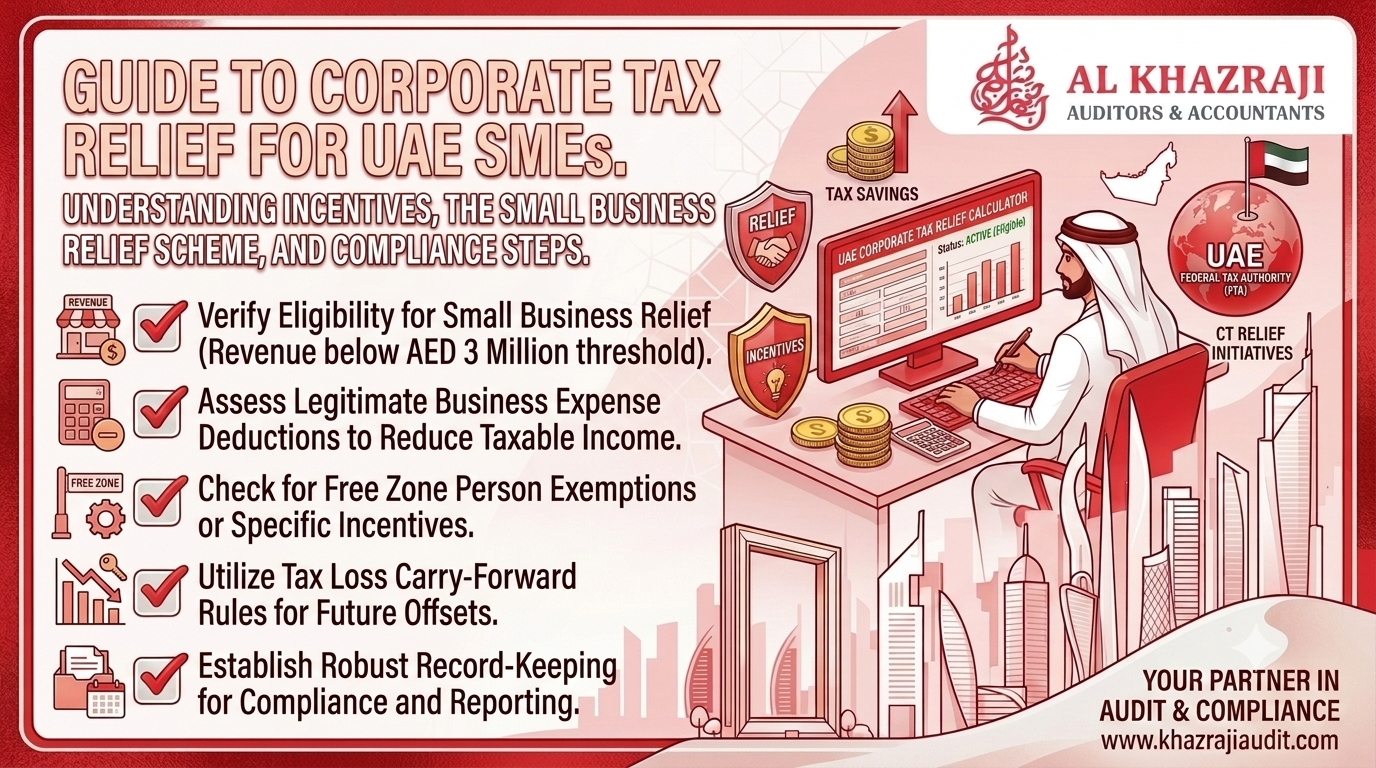
Can SMEs benefit from Corporate Tax Relief in the UAE?
A sharper tax decision starts with the right numbers.
For SMEs, startups, mainland companies and eligible free-zone businesses, UAE corporate tax compliance brings new decisions around revenue, tax history, legal status and filing.
Revenue is the threshold. Eligibility is the full picture.
This guide explains who may qualify, how the AED 3 million threshold works, what exclusions matter and how Abu Dhabi businesses can prepare.
Can SMEs Benefit from Corporate Tax Relief in the UAE? Eligibility, AED 3 Million Threshold and How to Apply
Target location: Abu Dhabi, UAE
Target audience: SMEs, startups, mainland businesses, eligible free zone businesses and small business owners
Primary keyword: Small Business Relief UAE
Secondary keywords: Corporate Tax Relief for SMEs UAE, UAE Corporate Tax Exemption, AED 3 Million Corporate Tax Threshold, Small Business Relief Abu Dhabi, Corporate Tax Advisory Services Abu Dhabi, Corporate Tax Consultants Abu Dhabi.
Introduction
Running a small or medium-sized enterprise (SME) in the UAE involves managing several financial and regulatory responsibilities. From maintaining accurate accounting records to meeting VAT obligations and corporate tax requirements, business owners must ensure that their financial operations comply with applicable regulations.
For many small businesses, corporate tax compliance can create additional administrative and financial responsibilities. This is particularly relevant for startups, consultancy firms, trading companies, professional service providers and family-owned businesses operating in Abu Dhabi and other Emirates.
To support smaller businesses, the UAE introduced Small Business Relief (SBR) under its Corporate Tax regime. This provision allows eligible Resident Persons with annual revenue of AED 3 million or less to elect to be treated as having no taxable income for a qualifying tax period.
The UAE Ministry of Finance announced an important extension on 7 August 2026. Under Ministerial Decision No. 131 of 2026, eligible businesses can continue to benefit from Small Business Relief for tax periods ending on or before 31 December 2029, provided they satisfy the applicable conditions.
However, not every business with revenue below AED 3 million automatically qualifies. Businesses must meet the eligibility requirements, consider previous tax periods, understand the exclusions and make the required election in their Corporate Tax return.
This guide explains how Small Business Relief works, who can benefit, how the AED 3 million threshold is calculated, what documents businesses should maintain and how SMEs in Abu Dhabi can manage their corporate tax obligations.

Eligibility is a decision framework, not a guess
Use the AED 3 million revenue threshold as the start of a structured review across legal status, tax history, exclusions and filing obligations.
What Is Small Business Relief Under UAE Corporate Tax?
Small Business Relief is a tax provision introduced under Article 21 of Federal Decree-Law No. 47 of 2022 on the Taxation of Corporations and Businesses.
It allows eligible Resident Persons to elect to be treated as having no taxable income for a particular tax period.
In practical terms, a business that meets the prescribed conditions can benefit from simplified corporate tax treatment without calculating and paying corporate tax on its income for that period.
The relief is implemented through Ministerial Decision No. 73 of 2023, as amended by Ministerial Decision No. 131 of 2026.
Key features of Small Business Relief
- Revenue threshold: Revenue must not exceed AED 3 million in the relevant tax period and every previous tax period.
- Eligible businesses: Resident Persons, including qualifying natural persons and juridical persons.
- Election requirement: Businesses must elect for Small Business Relief in their Corporate Tax return for each relevant tax period.
- Tax treatment: An eligible business is treated as having no taxable income for the period in which it makes a valid election.
- Extension: The relief applies to qualifying tax periods ending on or before 31 December 2029.
- Exclusions: Qualifying Free Zone Persons and certain members of multinational enterprise groups cannot elect for this relief.
It is important to understand that Small Business Relief is not the same as an automatic exemption from corporate tax registration or filing obligations. Eligible businesses must continue to meet the applicable administrative and record-keeping requirements.
Can SMEs Benefit from Corporate Tax Relief in the UAE?
Yes. SMEs can benefit from Small Business Relief if they meet the requirements under UAE Corporate Tax legislation.
The main eligibility condition is that the business must be a Resident Person and its revenue must not exceed AED 3 million in the relevant tax period or any previous tax period.
However, revenue is only one part of the eligibility assessment. The business must also consider its legal status, group structure, free zone status and previous corporate tax periods.
1. The business must be a Resident Person
Small Business Relief is available to eligible Resident Persons under the UAE Corporate Tax framework.
This can include:
- UAE-incorporated companies.
- Limited liability companies (LLCs).
- Eligible sole establishments and other businesses operated by natural persons.
- UAE-resident entities operating in Abu Dhabi and other Emirates.
For natural persons, corporate tax generally applies when revenue from business activities conducted in the UAE exceeds AED 1 million in a calendar year, subject to the applicable rules and exclusions.
A business owner should therefore first establish whether the activity and legal structure fall within the scope of UAE Corporate Tax.
2. Revenue must not exceed AED 3 million
The business must have revenue of AED 3 million or less during the relevant tax period.
The threshold applies to revenue, not net profit or taxable profit.
For example:
- Business A generates AED 2.4 million in annual revenue and AED 300,000 in profit.
- Business B generates AED 3.2 million in annual revenue and AED 150,000 in profit.
Business A may satisfy the revenue threshold, subject to the other eligibility conditions. Business B does not satisfy the threshold, even though its profit is relatively low.
3. Previous tax periods must also meet the threshold
One of the most important conditions is that the revenue threshold applies to the current tax period and every previous tax period.
A business cannot claim Small Business Relief simply because its revenue falls below AED 3 million in the current year.
For example, if a company generated AED 3.4 million in revenue in an earlier tax period, it cannot elect for Small Business Relief in a later period merely because its revenue has fallen to AED 2.5 million.
This condition makes it important for SMEs to review their complete tax-period history before making an election.
4. The business must not fall under an excluded category
Certain businesses are not permitted to elect for Small Business Relief, even if their revenue is below AED 3 million.
These include:
- Qualifying Free Zone Persons.
- Constituent companies of multinational enterprise groups meeting the applicable consolidated revenue threshold of EUR 750 million or more in the relevant period, as defined under the UAE legislation.
Businesses with complex group structures should obtain professional advice before assuming they qualify.
What Is the AED 3 Million Small Business Relief Threshold?
The AED 3 million threshold is the maximum revenue limit for businesses seeking to elect for Small Business Relief.
A common misunderstanding among business owners is that this amount represents the company's annual profit. It does not.
The threshold is based on revenue determined under the applicable accounting standards accepted in the UAE.
Revenue versus profit: What is the difference?
Revenue refers to the income generated through a business's ordinary operations and other amounts included in revenue under the applicable accounting standards.
Profit represents the financial result after deducting relevant business expenses from revenue.
Consider the following example:
A trading company in Abu Dhabi records the following financial figures:
| Financial item | Amount |
|---|---|
| Annual revenue | AED 2,800,000 |
| Cost of goods sold | AED 1,700,000 |
| Operating expenses | AED 750,000 |
| Accounting profit | AED 350,000 |
The company's revenue is AED 2.8 million, which is within the AED 3 million threshold.
However, the company must still satisfy the previous-period revenue condition, Resident Person requirement and other applicable eligibility conditions before electing for Small Business Relief.
The example illustrates why business owners should not use their net profit to determine eligibility.
What happens if business revenue exceeds AED 3 million?
If a business exceeds the AED 3 million threshold in any relevant or previous tax period, it cannot elect for Small Business Relief.
For example:
| Tax period | Annual revenue | SBR eligibility |
|---|---|---|
| 2024 | AED 1,800,000 | Eligible, subject to other conditions |
| 2025 | AED 2,400,000 | Eligible, subject to other conditions |
| 2026 | AED 3,200,000 | Not eligible |
| 2027 | AED 2,500,000 | Not eligible |
Once the business exceeds the threshold in a tax period, a later reduction in revenue does not restore eligibility under the existing rules.
This is particularly important for growing SMEs that are expanding their operations, entering new markets or securing larger customer contracts.
Small Business Relief Eligibility for Abu Dhabi Businesses
Abu Dhabi has a diverse business environment that includes mainland companies, free zone entities, startups, trading businesses, consultants and family-owned enterprises.
Each business must assess its corporate tax position according to its legal structure and activities.
Mainland SMEs in Abu Dhabi
Mainland companies operating in Abu Dhabi can potentially benefit from Small Business Relief if they qualify as Resident Persons and meet the revenue conditions.
Examples include:
- Retail and wholesale trading companies.
- Marketing and consultancy agencies.
- Construction-related service providers.
- Small professional service companies.
- Maintenance and facility management businesses.
- Local distributors and commercial trading businesses.
Mainland registration does not automatically qualify a business for relief. Revenue history and other eligibility conditions must still be checked.
Startups and newly established businesses
Startups may benefit from Small Business Relief during their early operating years if they meet the statutory conditions.
For example, a newly established Abu Dhabi consultancy company generates AED 900,000 in its first tax period.
If it is a Resident Person, is not excluded from the relief and satisfies all other requirements, it may elect for Small Business Relief.
Startups should establish proper accounting processes from the beginning rather than waiting until their first corporate tax return is due.
Free zone businesses
Free zone businesses require particular attention because not every free zone company receives the same corporate tax treatment.
A Qualifying Free Zone Person cannot elect for Small Business Relief. Such businesses must instead assess whether they qualify for the separate 0% corporate tax treatment on qualifying income under the applicable Free Zone rules.
A free zone entity that is not a Qualifying Free Zone Person may need to assess whether it can elect for Small Business Relief, provided it meets the remaining requirements.
For example, a free zone company that does not satisfy the conditions for Qualifying Free Zone Person status should not automatically assume it is excluded from SBR. Its eligibility requires an individual assessment.
Family-owned and small trading businesses
Family-owned enterprises and trading companies may also benefit if they meet the legal requirements.
However, businesses operating through several related entities should review their ownership, activities and commercial arrangements carefully.
Creating separate companies or artificially dividing business activities to remain below the revenue threshold can raise anti-abuse concerns.
A clear view of the difference
For a qualifying service company with AED 600,000 in illustrative taxable income, the example in this guide shows a potential AED 20,250 difference when relief is validly elected.

How Much Corporate Tax Can an SME Save?
The financial benefit of Small Business Relief depends on the company's taxable income, revenue history and eligibility.
Under the UAE Corporate Tax framework, the standard rates for ordinary taxable persons are:
- 0% on taxable income up to AED 375,000.
- 9% on taxable income exceeding AED 375,000.
Eligible businesses electing for Small Business Relief are treated as having no taxable income for that tax period.
Example: SME benefiting from Small Business Relief
Consider an Abu Dhabi-based service company with the following figures:
| Particulars | Amount |
|---|---|
| Annual revenue | AED 2,600,000 |
| Accounting profit | AED 600,000 |
| Illustrative taxable income | AED 600,000 |
| Revenue eligibility | Within AED 3 million |
Assuming the company meets all eligibility conditions and makes a valid election:
Without Small Business Relief:
- Taxable income: AED 600,000.
- 0% tax on the first AED 375,000.
- 9% tax on the remaining AED 225,000.
- Illustrative corporate tax: AED 20,250.
With Small Business Relief:
- The company is treated as having no taxable income for that tax period.
- Corporate tax payable on that income: AED 0.
Illustrative tax difference: AED 20,250.
This example assumes that AED 600,000 is the company's taxable income before applying the relevant tax treatment. Actual tax calculations can differ depending on adjustments, elections and the company's circumstances.
Important: Small Business Relief is different from the 0% corporate tax rate
Business owners should understand the difference between the standard 0% tax bracket and Small Business Relief.
| Standard corporate tax treatment | Small Business Relief |
|---|---|
| 0% on taxable income up to AED 375,000 | Eligible business treated as having no taxable income |
| 9% on taxable income above AED 375,000 | No corporate tax on income for the elected period |
| Applies under standard tax calculations | Requires a valid election |
| No AED 3 million revenue eligibility condition | AED 3 million revenue threshold applies |
A business that does not qualify for Small Business Relief may still benefit from the standard 0% corporate tax bracket on its first AED 375,000 of taxable income.
From revenue review to a confident election
Each step builds the evidence needed for a clean, defensible Corporate Tax return.
How Can SMEs Apply for Small Business Relief in the UAE?
Small Business Relief is not automatically applied to every business that falls below the revenue threshold.
The business must make the appropriate election in its Corporate Tax return for the relevant tax period.
The following steps can help SMEs manage the process.
Step 1: Complete corporate tax registration
Businesses should first establish their corporate tax registration position with the Federal Tax Authority.
Eligible businesses must not assume that Small Business Relief removes their registration obligations.
For assistance, businesses can refer to our guide on Corporate Tax Registration in the UAE.
Step 2: Review annual revenue
Calculate revenue for the relevant tax period using the applicable accounting standards.
Review the company's:
- Sales invoices.
- Service income.
- Trading revenue.
- Financial statements.
- Other relevant income included in revenue.
Do not use net profit as a substitute for revenue.
Step 3: Review previous tax periods
Check whether the business exceeded AED 3 million in any previous relevant tax period.
This is essential because exceeding the threshold in one period can prevent the business from claiming relief in subsequent periods.
Step 4: Check exclusions
Confirm whether the business:
- Qualifies as a Resident Person.
- Is a Qualifying Free Zone Person.
- Is a constituent company of an excluded multinational group.
- Has any complex ownership or related-party arrangements that require review.
Step 5: Make the election in the Corporate Tax return
Eligible businesses must select the Small Business Relief election when completing the Corporate Tax return for the relevant tax period.
The election must be considered separately for each tax period.
Step 6: Maintain appropriate financial records
Businesses should retain financial statements, accounting records, supporting documents and other relevant evidence.
Even when a company elects for Small Business Relief, it must continue meeting the applicable record-keeping requirements.
Important Conditions and Limitations of Small Business Relief
Although Small Business Relief can provide substantial benefits, businesses should understand its limitations before making an election.
1. Relief is not automatic
Businesses must make the required election in their Corporate Tax return.
Simply having annual revenue below AED 3 million does not automatically apply the relief.
2. Revenue must remain within the threshold
The AED 3 million limit applies to the relevant tax period and all previous tax periods.
A business that exceeded the limit in an earlier period cannot regain eligibility simply by reducing its revenue later.
3. Qualifying Free Zone Persons are excluded
A Qualifying Free Zone Person cannot elect for Small Business Relief.
Such entities should evaluate the separate Free Zone corporate tax rules.
4. Certain multinational group members are excluded
A constituent company of a multinational enterprise group that meets the applicable EUR 750 million consolidated revenue threshold is not eligible to elect for SBR.
5. Tax losses cannot be carried forward from relief periods
Where a business elects for Small Business Relief, tax losses incurred during that tax period cannot be carried forward.
This is an important consideration for startups and businesses that experience initial operating losses.
6. Net interest expenditure restrictions apply
Net interest expenditure incurred in a tax period for which Small Business Relief is elected cannot be carried forward under the relevant provisions.
Businesses with substantial borrowing or financing arrangements should assess the financial consequences before making the election.
7. Artificial business separation can create compliance risks
Businesses should not create artificial arrangements to divide their activities or revenue between multiple entities to remain below AED 3 million.
The UAE Corporate Tax framework contains anti-abuse provisions to address arrangements designed to obtain tax advantages that are not supported by genuine commercial reasons.
Common Corporate Tax Mistakes SMEs Should Avoid
Many small businesses make corporate tax decisions without reviewing their complete financial position.
The following mistakes can create unnecessary compliance risks.
1. Confusing revenue with profit
The AED 3 million eligibility threshold is based on revenue, not net profit.
2. Assuming every small company qualifies
Resident Person status, previous tax periods and exclusion rules must also be reviewed.
3. Ignoring previous tax periods
Businesses sometimes consider only their current financial year. This can lead to incorrect eligibility decisions.
4. Assuming free zone registration guarantees relief
Qualifying Free Zone Persons are specifically excluded from Small Business Relief.
5. Failing to make the election
Eligibility alone is insufficient. The required election must be made through the Corporate Tax return.
6. Maintaining incomplete accounting records
Incomplete invoices, missing expense records and inaccurate financial statements can make it difficult to establish the company's correct revenue and tax position.
7. Ignoring the impact of tax losses
Businesses should consider whether electing for relief could affect the future use of tax losses and net interest expenditure.
When Should an SME Consult a Corporate Tax Advisor in Abu Dhabi?
Professional corporate tax advice can help business owners understand their eligibility and avoid mistakes when preparing their tax returns.
An SME should consider consulting a corporate tax advisor when:
- Annual revenue is approaching AED 3 million.
- The business has exceeded AED 3 million in a previous tax period.
- The company operates through multiple legal entities.
- The business has mainland and free zone operations.
- There are related-party or cross-border transactions.
- The company has accumulated tax losses.
- Financial records are incomplete or inconsistent.
- The company is preparing its first Corporate Tax return.
- Business expansion may change its tax position.
A corporate tax advisor can review the business structure, financial records, revenue history and applicable regulations before recommending an appropriate tax treatment.
For companies that also need assistance with financial reporting and bookkeeping, professional Accounting Services in Abu Dhabi can support better financial record management.
How Al Khazraji Auditing Can Help SMEs With Corporate Tax Compliance
Understanding corporate tax regulations is important, but applying them correctly to daily business operations is equally necessary.
SMEs in Abu Dhabi may need support with corporate tax registration, revenue assessment, accounting records, tax return preparation and ongoing compliance.
Al Khazraji Auditing provides accounting, auditing and tax-related professional services to businesses that require support with their financial and regulatory responsibilities.
Businesses seeking corporate tax assistance can explore the following areas of support:
Corporate Tax Advisory
Businesses can seek assistance in understanding applicable corporate tax requirements, reviewing their eligibility for Small Business Relief and identifying relevant compliance considerations.
Corporate Tax Registration and Return Support
Professional assistance can help businesses understand registration requirements, prepare financial information and complete applicable corporate tax return processes.
Accounting and Bookkeeping
Accurate accounting records are important for determining revenue, reviewing business expenses and preparing financial statements.
Corporate Tax Planning
Businesses can review their financial structure, business activities and tax position to understand applicable tax treatments and plan for future compliance obligations.
Financial Record and Compliance Review
Reviewing financial records can help identify missing documents, reporting inconsistencies and potential compliance issues before filing.
The appropriate service scope should be determined according to the company's business activities, legal structure and financial circumstances.
If your business operates in Abu Dhabi and you need guidance on Small Business Relief, corporate tax registration or tax return preparation, contact Al Khazraji Auditing to discuss your requirements.
Book a Corporate Tax Consultation with Al Khazraji Auditing.
Website: https://www.khazrajiaudit.com/
Frequently Asked Questions About Small Business Relief in the UAE
1. Can SMEs benefit from corporate tax relief in the UAE?
Yes. Eligible SMEs can benefit from Small Business Relief if they qualify as Resident Persons, have revenue of AED 3 million or less in the relevant and all previous tax periods, are not excluded and make the required election in their Corporate Tax return.
2. What is the AED 3 million Small Business Relief threshold?
AED 3 million is the maximum revenue threshold for businesses seeking to elect for Small Business Relief. Revenue must not exceed this amount in the relevant tax period or any previous tax period. The threshold is based on revenue, not net profit.
3. Is Small Business Relief available until 2029?
Yes. The UAE Ministry of Finance announced an extension through Ministerial Decision No. 131 of 2026. Eligible businesses can elect for relief for tax periods ending on or before 31 December 2029, subject to the applicable conditions.
4. Does a business need to register for corporate tax to claim relief?
Eligible businesses must comply with applicable corporate tax registration requirements. Small Business Relief does not automatically remove the obligation to register with the Federal Tax Authority.
5. Is Small Business Relief automatically applied?
No. Eligible businesses must make the appropriate election in their Corporate Tax return for each relevant tax period. Falling below the AED 3 million revenue threshold alone does not automatically grant the relief.
6. Can a mainland company in Abu Dhabi claim Small Business Relief?
Yes. A mainland company in Abu Dhabi may qualify if it is a Resident Person, meets the revenue threshold for the current and all previous relevant tax periods, is not excluded and makes the required election.
7. Can free zone companies benefit from Small Business Relief?
It depends on their tax status. Qualifying Free Zone Persons cannot elect for Small Business Relief. A free zone entity that does not qualify as a Qualifying Free Zone Person may be able to elect if it satisfies all other requirements.
8. What happens if my business revenue exceeds AED 3 million?
If revenue exceeds AED 3 million in any relevant or previous tax period, the business cannot elect for Small Business Relief in subsequent periods under the existing threshold rules. It must assess its corporate tax liability under the standard regime.
9. Is the AED 3 million threshold based on revenue or net profit?
It is based on revenue determined according to applicable accounting standards accepted in the UAE. It is not based on net profit or taxable income.
10. Can a startup with no taxable profit claim Small Business Relief?
A startup may be eligible if it meets the Resident Person and revenue requirements and is not excluded. However, having no taxable profit does not automatically establish eligibility. The business must still satisfy the statutory conditions and make the required election.
11. Do SMEs still need to file corporate tax returns?
Yes. A business electing for Small Business Relief must still submit its Corporate Tax return for the relevant tax period. The election simplifies certain tax calculations but does not remove the filing obligation.
12. Can a business carry forward tax losses during a Small Business Relief period?
Tax losses incurred in a period for which Small Business Relief is elected cannot be carried forward. Businesses should consider this before making the election, particularly if they expect future taxable profits.
13. What documents should SMEs maintain to claim Small Business Relief?
Businesses should maintain appropriate financial statements, accounting records, sales invoices, bank statements, expense records, contracts and other supporting documents relevant to their revenue and business activities. These records help establish eligibility and support tax compliance.
14. Can a business claim Small Business Relief every financial year?
Yes, if it remains eligible for each relevant tax period and makes the required election each time. The business must continue satisfying the AED 3 million threshold in the current and all previous relevant tax periods.
15. Can a company split its business to remain below AED 3 million?
Artificially separating business activities or revenue to obtain Small Business Relief can create significant tax risks. The UAE Corporate Tax framework contains anti-abuse provisions. Genuine commercial arrangements should be distinguished from artificial structures designed to obtain tax benefits.
Conclusion: Should Your SME Consider Small Business Relief?
Small Business Relief can provide meaningful corporate tax benefits to eligible SMEs, startups and other small businesses operating in Abu Dhabi and across the UAE.
The AED 3 million revenue threshold, Resident Person requirement, previous tax-period conditions and specific exclusions determine whether a business can elect for the relief.
However, businesses should not make this decision based only on their annual revenue. They should also review their legal structure, financial records, previous tax periods, free zone status and potential implications for tax losses.
Maintaining accurate accounting records and understanding the applicable corporate tax regulations can help businesses make informed decisions and manage their compliance responsibilities.
If you operate an SME, startup or trading company in Abu Dhabi and want to understand whether your business qualifies for Small Business Relief, professional guidance can help you assess your position.
Contact Al Khazraji Auditing to book a Corporate Tax Consultation and discuss your business's corporate tax requirements.
Website: https://www.khazrajiaudit.com/
Trusted for practical, professional support.
A testimonial treatment inspired by the Google Business Profile content provided for Al Khazraji Auditing. Keep the live review link connected so visitors can verify the source and read the latest feedback.
“The service was exceptional! The team went above and beyond to ensure everything was perfect. I highly recommend them to anyone looking for quality and professionalism.”John Doe · Google Review · 2 weeks ago
Review the live profile
See the latest ratings, reviewer names and approved Google Business Profile testimonials directly from the source.
View Google profile ↗Confidence for growing SMEs
For a full picture of client experience, use the live profile link to browse the firm’s current public feedback before booking a consultation.
Read latest reviews ↗Know where your business stands before you make the election.
Contact Al Khazraji Auditing to discuss Small Business Relief, corporate tax registration, tax return preparation and the accounting records your business should maintain.
Book a Corporate Tax Consultation ↗